Marches in Barcelona, Girona and Amposta send a clear message: support for Catalonia’s independence remains strong and regains momentum
The 2026 Diada demonstrations have been a major success, bringing supporters of Catalonia’s independence onto the streets of three Catalan cities. Under the slogan “I am here. We are here. For the present and the future, independence”, Catalans have once again shown that the struggle for self-determination is far from over, and that support is growing among the younger generations.
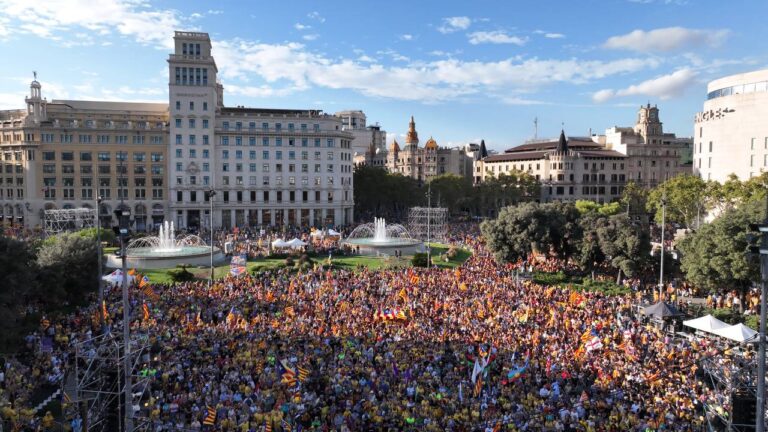
The main demonstration took place in Barcelona. Two columns representing the present and the future marched towards each other from separate points, joining at Plaça Catalunya, where the political event was held.
In the closing speech, Catalan National Assembly (Assemblea) president Pep Vila called for past mistakes to be turned into lessons, and to initiate a new phase. “The civil pro-independence movement must lead at this turning point: a collective and continuous action in our struggle for national liberation” –added the president. He also announced that within a month, Assemblea will convene a summit with pro-independence civil society organisations to share this commitment and build the necessary alliances to move it forward.
Vila also denounced the dire situation Catalonia is enduring, pointing to inadequate infrastructure, a failing railway system, precarious working conditions for healthcare staff, an under-resourced education system, unaffordable housing and complete neglect for the agricultural sector. “There is a clear underlying structural cause for this Catalonia that is just not functioning: the lack of self-governance, the impossibility of managing our own resources and the Spanish plunder […]. There is only one way out of this: building a Catalan Republic”, he said.
The demonstration was jointly organised by Assemblea, Òmnium Cultural, the Association of Municipalities for Independence (AMI), the Council of the Republic, the Intersindical trade union, and the minority rights organisation CIEMEN. This highlights the breadth and diversity of the Catalan pro-independence movement.
This diversity was also reflected in the days leading up to the Diada, when all seven presidents who have led Assemblea since its foundation in 2011 met at the organisation’s headquarters. The gathering symbolised Assemblea’s breadth and determination, as well as its ability to bring together people from different backgrounds, values and perspectives around a shared goal: making Catalonia’s independence possible.
International presence
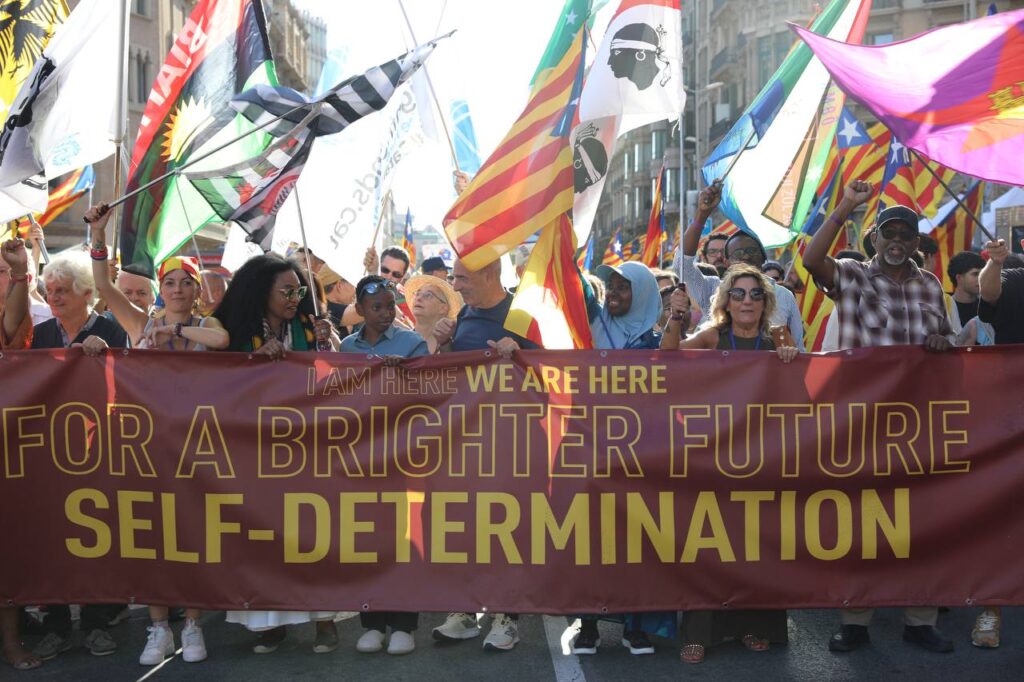
Catalonia also received the solidarity of dozens of international activists, representatives and academics who travelled to Barcelona to join the demonstration. Participants from Kabylia, Quebec, Flanders, New Caledonia, Sardinia, Biafra, Brittany, Kurdistan, Galicia, the Basque Country, the South Moluccas, Germany, Ogaden, Wallmapu, Puerto Rico, Western Sahara and Kashmir, among others, marched alongside Catalan demonstrators under a banner in support of the right of peoples to self-determination.
On the occasion of the Catalan National Day, several of Assemblea’s international branches also mobilised the Catalan diaspora, organising political, cultural and social activities in places such as France, the Netherlands, the UK, Belgium or Mexico.