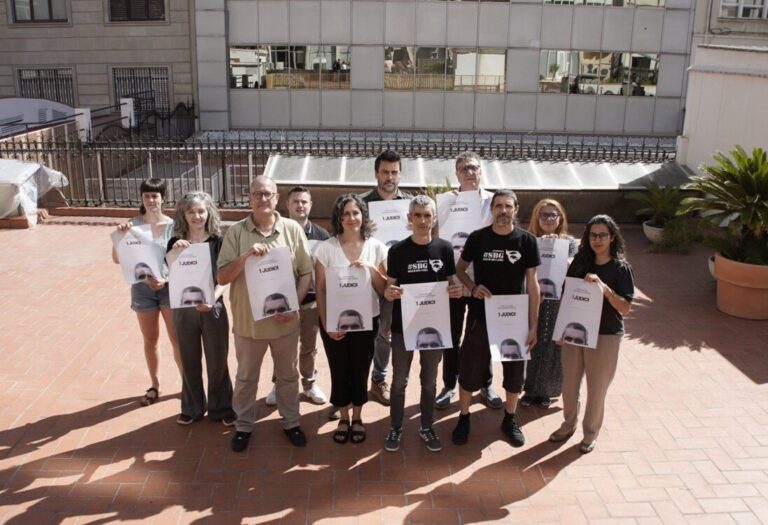
Hearings will begin on 16 September and are key to determining whether the shot was intentional and whether it may constitute torture.
More than a hundred human rights and social organisations and over 50 figures from the worlds of culture and the media have launched a public campaign in support of Roger Espanyol ahead of the trial, which will take place on 16, 17 and 30 September and 1 October 2026.
Nine years after the events, the organisations behind the campaign denounce the police violence perpetrated during the events around the 1 October independence referendum, which left 1,066 casualties, and call for truth, justice, reparation and guarantees of non-repetition.
The organisations recall that this is the only case arising from the police repression on that day that has come to trial, a fact they consider especially significant in a context marked by a lack of accountability for what happened.
A united campaign for human rights and reparation
The initiative is led by Irídia, Stop Bales de Goma (Stop Rubber Bullets), Alerta Solidària, Novact, Òmnium Cultural, the Catalan National Assembly and the CIIVO International Center for Research on Ocular Violence.
According to these organisations, the initiative seeks to “focus on the need for justice and reparation for the victims of police violence on October 1st, and to demand that similar situations never happen again”.
Manifesto and endorsements
The manifesto in support of Roger Espanyol was presented at a press conference. It has been signed by over one hundred human rights and social organisations and more than 40 figures from the worlds of culture and the media.
The manifesto denounces that the police violence on that day followed “a standardised and systematic pattern” intended to repress fundamental rights, and calls for “those responsible for Roger’s mutilation and for the violence of October 1st to be convicted”, recalling that “only a conviction can guarantee justice and reparation”.
The text has been endorsed, among others, by Jordi Évole, Marc Giró, Olga Rodríguez, Juliana Canet, Manel Vidal, Sergi López, Clara Peya, Judit Neddermann, Yolanda Sey and Jordi Borràs. The endorsements reflect the support of a broad spectrum of the cultural and media sectors for the need for truth, justice and reparation.
Statements
Roger Espanyol and representatives of the organisations promoting the campaign spoke at the event, where they set out the objectives of the initiative and the actions planned ahead of the trial.
Josep Vila, president of the ANC:
“The Spanish State responded to that democratic expression with repression. And nine years later, it continues to show its democratic shortcomings when victims have to fight for almost a decade for a single case to come to trial. The ANC is involved as a private prosecutor.”
“The cause that led millions of Catalans to defend the ballot boxes remains alive. We remain vigilant, organised and ready to democratically defend our right to decide and to complete the path to independence.”
Anaïs Franquesa, director of Irídia:
“After almost nine years of work, we have managed to bring to trial the four [Spanish] National Police officers responsible for the mutilation of Roger Espanyol on 1 October 2017. Getting this far has been an obstacle course, because fighting against impunity for police violence always is; but in a case with such great political and symbolic significance, the difficulties multiply.”
“We have come this far with a bittersweet feeling: the trial against the four officers who mutilated Roger is the exception to the rule. But this case represents much more than one specific victim: it represents all those who denounce police violence and encounter obstacles in accessing truth, justice and reparation.”
Roger Espanyol, victim of the violence of October 1st and member of Stop Bales de Goma:
“We are launching this campaign to denounce the repression carried out by the Spanish State in response to the exercise of fundamental rights and, once again, the excessive use of force by police forces, especially through the use of less-lethal weapons during 1 October 2017.”
“Even if this trial were to end in a conviction, reparation would not be complete. Four police officers are being tried out of an operation that mobilised 10,000 officers and caused more than 1,000 casualties. I feel the responsibility for this trial to also represent all those people who have not had access to justice or reparation.”
Xavier Antich, president of Òmnium:
“The trial in the Roger Espanyol case is important because we have ensured that the police officers have not been amnestied, and because it keeps open the possibility of justice in the face of impunity for police violence on 1 October. Òmnium will be present at this trial as one of the private prosecutions to defend truth, justice, reparation and the collective rights of the people of Catalonia.”
“This is about turning an individual case into a class action against State impunity, while seeking justice, denouncing a serious violation of rights and continuing to affirm that, almost ten years later, the consensus around the right to self-determination remains intact, with close to 80% support and international recognition. Let us therefore turn this trial into a new indictment against the State.”
About the case
Roger Espanyol lost an eye as a result of being struck by a rubber bullet during the police operation of 1 October 2017 in Barcelona. The case comes to trial nine years after the events.
The four Spanish National Police officers accused — the officer who fired the shot and his three commanding officers — face charges of causing injury with the loss of a major organ, and of torture. The Public Prosecutor’s Office, however, considers that the acts do not constitute a criminal offence due to the exemption of “acting in the performance of duty”. The investigation has made it possible to provisionally establish that the officer fired up to three times, and that the shot that caused the removal of the eye was fired from a distance of 14.12 metres, in complete breach of regulations.
The trial will determine whether the events constitute a crime of torture — which could establish a significant legal precedent, including internationally — a crime of injury involving the loss of a major organ, a crime of negligent injury, or whether, on the contrary, there is no criminal liability due to the exemption invoked by the Public Prosecutor’s Office.