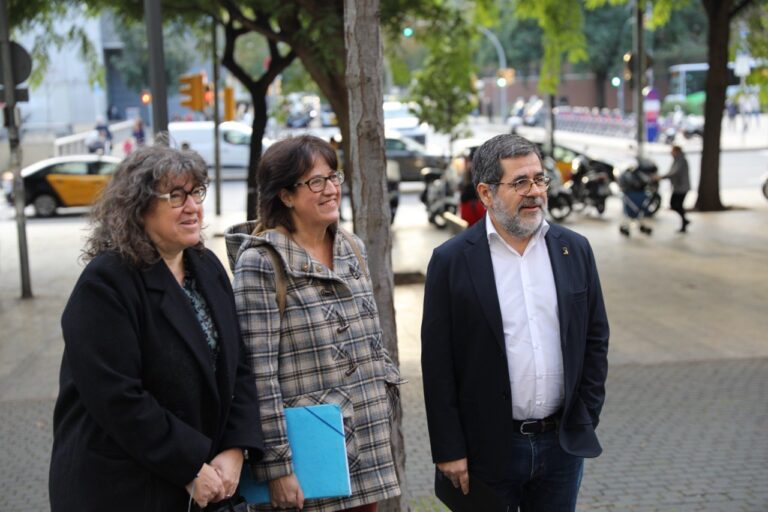
The CNI denies spying on Jordi Sànchez between 2015 and 2017 and on Sònia Urpí in 2020, despite the numerous pieces of evidence showing that their mobile phones were infected during those periods.
The Spanish Intelligence Centre (CNI) has acknowledged spying on former ANC presidents Elisenda Paluzie and Jordi Sànchez with judicial authorisation from the Supreme Court, in Paluzie’s case as of July 2019, and in Sànchez’s case since March 2020.
This is recorded in the declassified documents received just before the statement by CNI director Esperanza Casteleiro today, in which she confirmed in response to questions from Toni Abat, the lawyer for the ANC victims.
However, there is evidence showing that Jordi Sànchez received the first message with a link with Pegasus in 2015, and that his mobile phone was subjected to a malicious campaign using the same software between 11 September and 13 October 2017. All these infections fall outside the period for which there is judicial authorisation from the Supreme Court.
The CNI has also denied spying on former ANC national secretary Sònia Urpí, despite four independent expert reports—by Citizen Lab, Amnesty International, Eventia and the Catalan Police (Mossos d’Esquadra)—indicating that her phone was infected in 2020, coinciding with her joining the ANC’s national secretariat.
Spanish legislation (Article 588 of Law 13/2015) only permits such intrusive surveillance within the framework of criminal proceedings, and in strict accordance with the principles of exceptionality, necessity and proportionality. These requirements are not met in the case of the independence leaders and activists, who were spied on for their political, democratic and legitimate activities, as confirmed by the content of the declassified documents authorised by the Spanish Cabinet.
In both the cases of Jordi Sànchez and Elisenda Paluzie, the CNI justifies its espionage on national security grounds, solely on the basis of their political activity in support of independence. For Sànchez, the justification refers to his participation in videoconferences in 2020 aimed at rebuilding a unified pro-independence strategy. For Paluzie, the CNI cites her public statements as president of the ANC and the organisation’s roadmaps defending the unilateral path to independence.
As these activities are fully legitimate and democratic, Assemblea will continue all legal action necessary to secure a conviction of the Spanish state for its actions against its former presidents. It will also continue its work to uncover who else within the organisation may have been targeted.
Massive espionage against the Catalan independence movement
The spying on former ANC leaders forms part of Catalangate, the largest known case of political espionage in Europe. At least 65 Catalans—including activists, politicians, journalists and lawyers—were targeted using the highly intrusive Pegasus and Candiru spyware, developed by Israeli companies that are theoretically authorised to sell such tools only to states.
Although the scandal came to light in 2022, investigations have since stalled, despite recommendations from the United Nations Human Rights Committee and Special Rapporteurs, the European Parliament, and leading international human rights organisations. The victims have received no explanation, no reparations, and no accountability has been enforced.
Assemblea reaffirms its commitment to pursuing this case to its conclusion and to denouncing—both nationally and internationally—this flagrant abuse of fundamental rights, which cannot be allowed to go unpunished.